
New Zealand’s Modern Slavery Bill: What Australian Businesses Operating in New Zealand Need to Know
July 2026
Write your awesome label here.
Key takeaways
- Australian businesses should not assume that their existing Australian modern slavery statement will be sufficient for New Zealand.
- The proposed NZ regime introduces different coverage rules, a different reporting period and materially broader disclosure requirements.
- Its controller provision may also bring Australian parent companies into scope where they control a covered NZ entity.
- The first step is to identify the correct legal entities. The next is to determine whether the business has the systems and evidence needed to support disclosure of incidents, complaints, remediation, training, worker consultation and continuous improvement.
- Businesses with substantial New Zealand operations should begin this review now while continuing to monitor amendments made during the parliamentary process.
New Zealand is moving closer to introducing mandatory modern slavery reporting.
The Modern Slavery Bill passed its first reading on 29 April 2026 and is currently being considered by the New Zealand Parliament’s Education and Workforce Committee. The Committee’s report is due by 30 August 2026. The Bill is not yet law and may be amended before it is enacted. However, Australian businesses with New Zealand subsidiaries, stores, employees, property interests, distribution arrangements or other substantial New Zealand operations should begin assessing their potential exposure now.
The proposed requirements go further than the current Australian Modern Slavery Act in several important respects. They include mandatory disclosure of modern slavery incidents and complaints, supply-chain employee training and consultation, civil and criminal penalties and possible personal liability for directors and managers. The Bill may also capture Australian parent companies that directly or indirectly control a reporting entity in New Zealand.
Which businesses would be required to report?
Under the Bill as currently drafted, an entity would generally be a reporting entity where:
it has consolidated revenue of more than NZ$100 million during the reporting period; and
it is a New Zealand entity or an overseas company carrying on business in New Zealand.
The Bill would also make the following entities reporting entities:
- an entity that directly or indirectly controls an entity meeting the above requirements; and
- any other entity prescribed by regulation.
The proposed NZ$100 million threshold is based on consolidated revenue. If an entity controls other entities, the revenue of the entity and all its controlled entities is considered together.
Control would be determined in accordance with generally accepted accounting practice.
The NZ$100 million threshold could also be changed by regulation.
Why the controller provision matters
The controller provision is particularly significant for Australian corporate groups.
An Australian parent company may become a reporting entity because it controls an in-scope New Zealand subsidiary—even if the Australian parent would not otherwise be regarded as carrying on business in New Zealand.
Consider the following simplified structure:
Australian ultimate parent company
↓
Australian intermediate holding company
↓
New Zealand operating company with more than NZ$100 million consolidated revenue
The New Zealand operating company would be a reporting entity because it is a New Zealand entity exceeding the revenue threshold. Depending on how the controller provision is ultimately interpreted, the Australian intermediate holding company and Australian ultimate parent could also be reporting entities because they directly or indirectly control the New Zealand company.
Businesses should therefore assess coverage at the legal-entity and corporate-group level, rather than looking only at the brand or immediate New Zealand operating company.
What is a New Zealand entity?
The Bill defines a New Zealand entity as an entity that:
- is established under New Zealand law; or
- has its central management and control in New Zealand.
The Bill’s definition of “entity” is broad. It includes companies, other bodies corporate, trusts, partnerships and associations of persons.
This is important for Australian groups operating through trusts and corporate trustees.
The relevant analysis may need to consider:
- operating companies;
- corporate trustees;
- underlying trading trusts;
- New Zealand subsidiaries;
- Australian intermediate holding companies;
- the ultimate parent entity;
- employing entities;
- importing and distribution entities;
- property companies; and
- shared-services entities.
What does “carrying on business in New Zealand” mean?
The Bill would apply to an “overseas company that carried on business in New Zealand”, but it does not provide a detailed test specifically addressing online and cross-border business models. Whether an Australian company is carrying on business in New Zealand will depend on the substance, continuity and extent of its New Zealand activities. Merely making a small number of sales to customers in New Zealand may not, by itself, mean an Australian company is carrying on business there. The position becomes progressively stronger where the company has local premises, employees, inventory, agents, distribution arrangements or other ongoing operations.
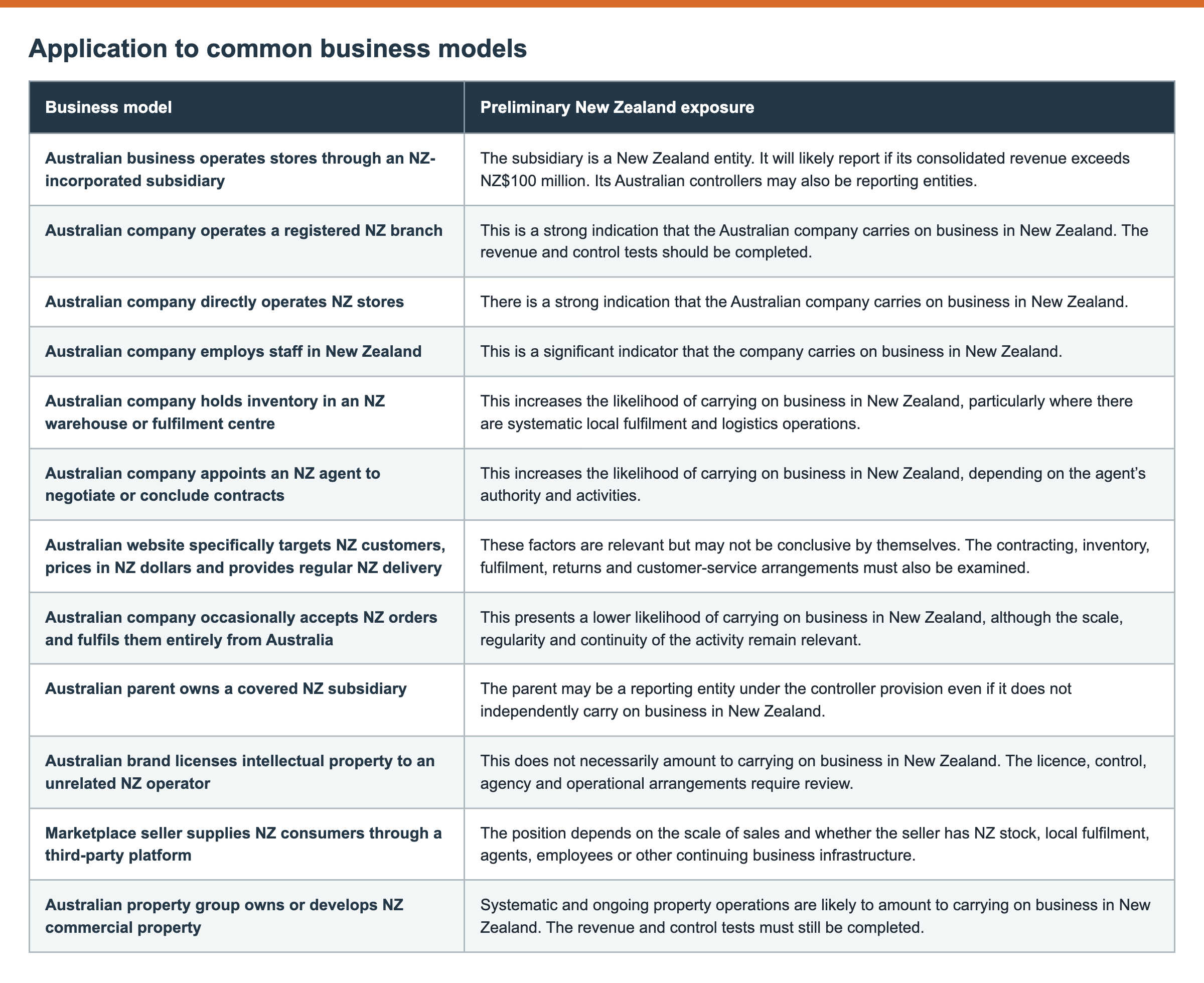
These examples provide preliminary indicators only. Businesses should obtain advice based on their actual corporate, contracting and operational arrangements.
Brands are not necessarily reporting entities
Corporate groups often refer to their businesses by brand name, but modern slavery legislation applies to legal entities.
A retail brand might be operated by:
A private-label brand may only be a registered business name rather than a separate company.
Brands are not necessarily reporting entities
Corporate groups often refer to their businesses by brand name, but modern slavery legislation applies to legal entities.
A retail brand might be operated by:
- an Australian company acting as trustee for a trading trust;
- a separate New Zealand subsidiary;
- an intellectual-property holding company;
- an importing or distribution entity;
- a property company;
- an employing entity; or
- different companies in different countries.
A private-label brand may only be a registered business name rather than a separate company.
Before determining which entities must report, businesses should prepare a verified entity map.
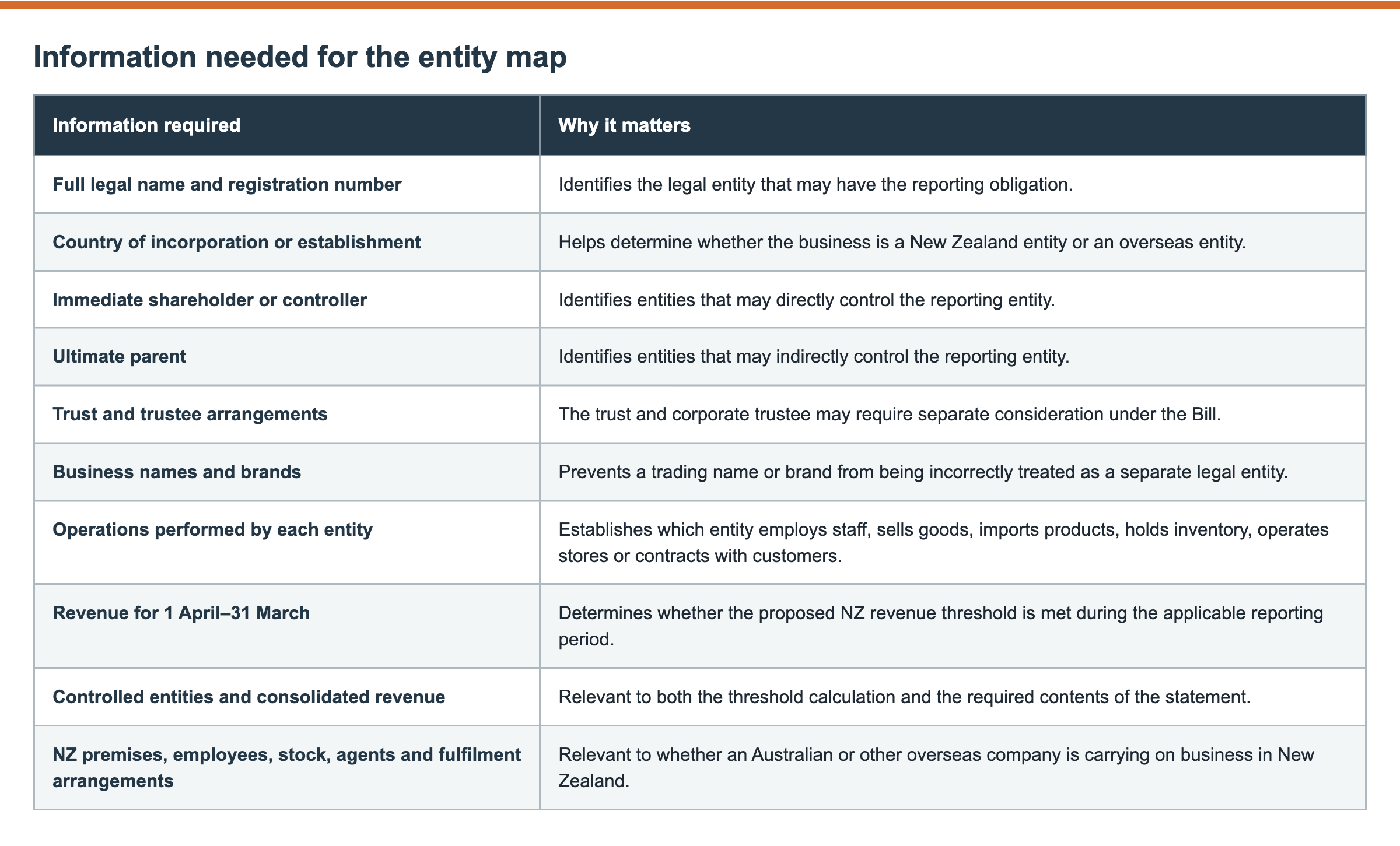
The entity map should be supported by current company extracts, trust documents, financial information and an explanation of the activities performed by each entity.
What would a modern slavery statement have to contain?
A reporting entity would have to prepare a statement for each reporting period and submit it to the Registrar within six months after the end of that period.
For private-sector entities, the Bill sets a fixed reporting period of 1 April to 31 March. A statement would therefore ordinarily be due by 30 September.
1. Entity, structure, operations and supply chains
2. Actual modern slavery incidents
3. Known and anticipated risks
4. Actions and due diligence
5. Complaints and investigations
6. Remediation
7. Effectiveness and continuous improvement
8. Training
9. Consultation
10. Other prescribed information
How does the NZ Bill compare with the Australian Act?
What would a modern slavery statement have to contain?
A reporting entity would have to prepare a statement for each reporting period and submit it to the Registrar within six months after the end of that period.
For private-sector entities, the Bill sets a fixed reporting period of 1 April to 31 March. A statement would therefore ordinarily be due by 30 September.
A statement would need to include the following information.
1. Entity, structure, operations and supply chains
The reporting entity must identify itself and describe its structure, domestic and international operations and supply chains, including its owned and controlled entities.
2. Actual modern slavery incidents
The entity must describe any modern slavery incident that occurred in its operations or supply chains, including those of its owned or controlled entities.
This is more specific than the current Australian mandatory criteria, which focus primarily on risks and the actions taken to assess and address those risks.
3. Known and anticipated risks
The statement must describe known or anticipated modern slavery risks across the relevant operations and supply chains.
This will require businesses to consider existing risks and emerging risks that can reasonably be anticipated.
4. Actions and due diligence
The entity must describe the actions taken to assess, prevent, address, mitigate and remediate modern slavery and related risks.
The Bill defines due diligence as an ongoing and systematic process. This reinforces that modern slavery compliance should operate throughout the year and not be treated solely as an annual reporting exercise.
5. Complaints and investigations
The statement must disclose:
the number of modern slavery complaints received; and
the measures taken to investigate those complaints.
Businesses will need a reliable process for determining which complaints fall within the modern slavery definition and for consolidating information from different reporting channels.
6. Remediation
The entity must describe the remediation provided for identified modern slavery incidents.
Remediation may involve more than requiring a supplier to complete a corrective-action plan. Depending on the circumstances, it may require direct engagement with affected workers and measures to restore them to the position they would have been in had the harm not occurred.
7. Effectiveness and continuous improvement
The statement must explain:
how the entity assesses the effectiveness of its actions; and
how its processes and policies are being continually improved.
This will require meaningful measures rather than simply listing activities completed during the year.
8. Training
The statement must describe modern slavery identification training provided to:
the reporting entity’s employees;
employees of owned and controlled entities; and
employees of other entities in the reporting entity’s supply chain.
The express reference to supply-chain employees could require businesses to extend training beyond their own employees and buying teams.
9. Consultation
The entity must describe consultation with the employees identified above, including employees of supply-chain entities.
This could require consultation with workers employed by suppliers, manufacturers, labour-hire providers, logistics businesses, cleaning contractors, security contractors and other service providers.
10. Other prescribed information
Regulations may prescribe additional information that must be included in a statement.
The statement must be signed by an authorised person.
How does the NZ Bill compare with the Australian Act?
Australian businesses that already submit modern slavery statements will have a useful foundation. However, an Australian statement should not be assumed to satisfy the New Zealand requirements without additional work.
The principal differences are set out below.
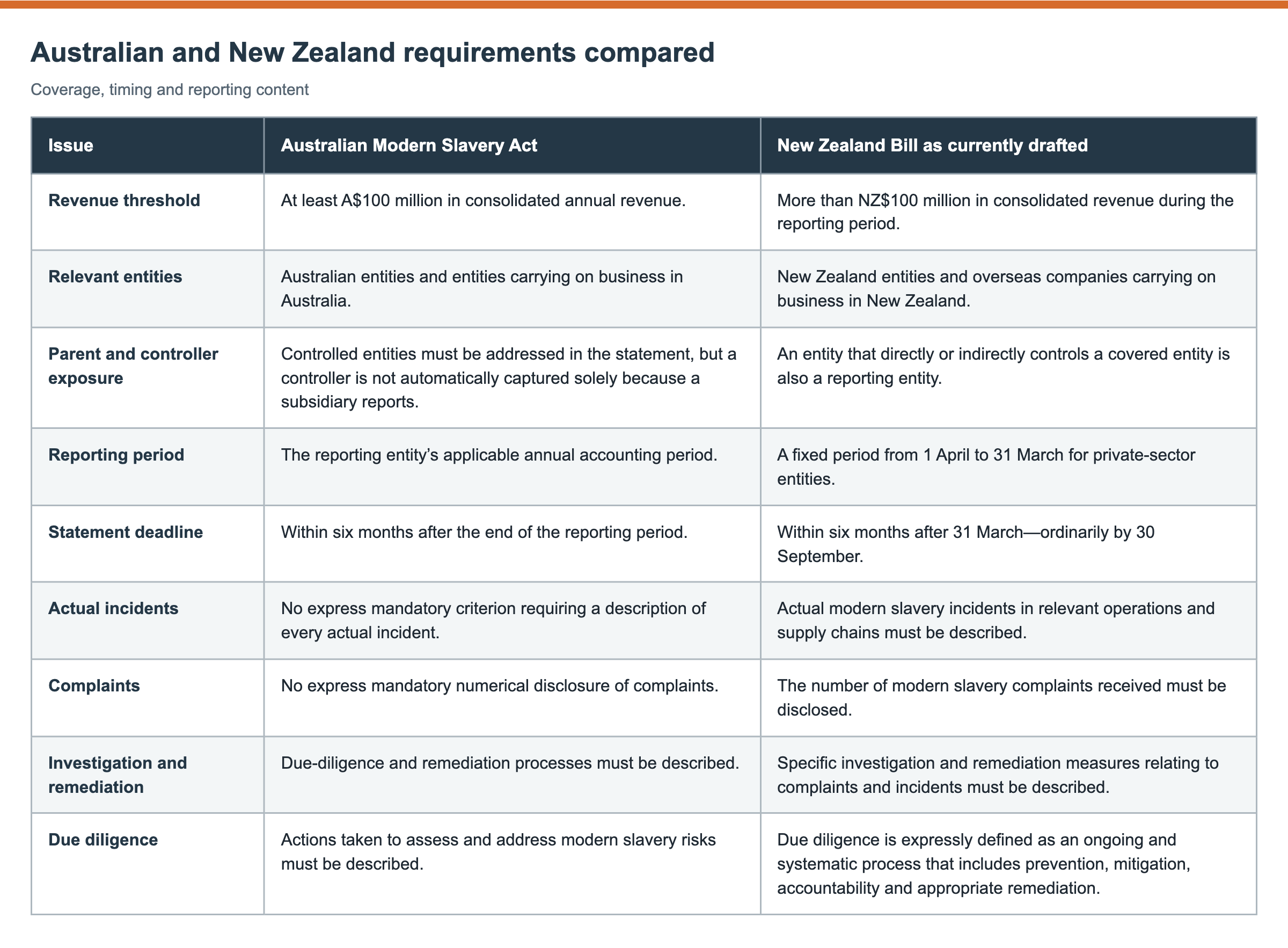
An Australian corporate group may therefore need to:
The Bill does not presently contain the same detailed joint-statement mechanism found in the Australian Act. Groups with multiple potential reporting entities will need to monitor whether this issue is addressed during the parliamentary process or through regulations and guidance.
A broader definition of modern slavery
The Bill covers familiar forms of modern slavery, including:
However, the definition of forced or exploitative labour is particularly significant.
It includes work or services involving a serious violation of legislation relating to employee rights or workplace health and safety.
This could broaden the labour issues that businesses must identify, investigate and potentially disclose.
Businesses should ensure their modern slavery process is connected with information held by:
Information should not remain isolated in separate business functions where it may be relevant to a modern slavery incident, complaint or disclosure.
Penalties and management exposure
Under the Bill as drafted, a reporting entity that fails to prepare, submit or properly publish its statement may face:
A director or person involved in management may also be guilty of an offence where:
Convictions and civil penalty orders would be published on the register for three years.
The Bill also proposes restrictions preventing the New Zealand Crown from paying money to certain entities that have been convicted or penalised for reporting contraventions. This could create additional consequences for government contractors and suppliers.
What Australian businesses should do now
Businesses do not need to prepare an NZ statement yet. The Bill remains before Parliament and may be amended.
However, the work needed to support the proposed disclosures cannot be completed effectively at the end of the reporting period. Businesses should consider taking the following preparatory steps now.
1. Map the legal-entity structure
2. Test the revenue threshold
3. Examine the NZ business nexus
4. Compare the existing statement against the NZ criteria
Businesses already reporting in Australia should conduct a criterion-by-criterion gap assessment. Particular attention should be given to:
5. Establish incident and complaints records
Create a central process to identify and record:
6. Strengthen supply-chain due diligence
Prioritise suppliers and service providers using risk factors such as:
7. Plan supplier and worker training
8. Develop a worker consultation approach
Depending on the risk, appropriate mechanisms may include:
9. Establish effectiveness measures
- determine whether additional Australian parent entities are captured;
- manage a different reporting period;
- collect new incident and complaints data;
- document supply-chain employee training and consultation;
- strengthen investigation and remediation processes;
- publish the statement in two places; and
- establish additional board and management assurance controls.
The Bill does not presently contain the same detailed joint-statement mechanism found in the Australian Act. Groups with multiple potential reporting entities will need to monitor whether this issue is addressed during the parliamentary process or through regulations and guidance.
A broader definition of modern slavery
The Bill covers familiar forms of modern slavery, including:
- slavery;
- servitude;
- trafficking in persons;
- debt bondage;
- sexual exploitation;
- forced or exploitative labour; and
- the worst forms of child labour.
However, the definition of forced or exploitative labour is particularly significant.
It includes work or services involving a serious violation of legislation relating to employee rights or workplace health and safety.
This could broaden the labour issues that businesses must identify, investigate and potentially disclose.
Businesses should ensure their modern slavery process is connected with information held by:
responsible sourcing;
- procurement;
- human resources;
- workplace relations;
- health and safety;
- legal and compliance;
- whistleblower teams;
- customer complaints;
- supplier-audit teams; and
- property and facilities management.
- Relevant warning signs may include:
- underpayment or unlawful deductions;
- excessive or involuntary overtime;
- recruitment fees;
- debt bondage;
- withholding passports or identity documents;
- threats or intimidation;
- restrictions on worker movement;
- unsafe accommodation;
- serious workplace safety violations;
- deceptive recruitment;
- labour-hire abuses;
- unauthorised subcontracting; and
- allegations involving migrant or temporary workers.
Information should not remain isolated in separate business functions where it may be relevant to a modern slavery incident, complaint or disclosure.
Penalties and management exposure
Under the Bill as drafted, a reporting entity that fails to prepare, submit or properly publish its statement may face:
- a criminal fine of up to NZ$200,000; or
- a civil pecuniary penalty of up to NZ$600,000.
- A person who knowingly includes false or misleading information in a statement may face a fine of up to NZ$200,000.
A director or person involved in management may also be guilty of an offence where:
- the conduct occurred with their authority, permission or consent; or
- they knew, or could reasonably have been expected to know, that the offence was being or would be committed and failed to take all reasonable steps to prevent or stop it.
Convictions and civil penalty orders would be published on the register for three years.
The Bill also proposes restrictions preventing the New Zealand Crown from paying money to certain entities that have been convicted or penalised for reporting contraventions. This could create additional consequences for government contractors and suppliers.
What Australian businesses should do now
Businesses do not need to prepare an NZ statement yet. The Bill remains before Parliament and may be amended.
However, the work needed to support the proposed disclosures cannot be completed effectively at the end of the reporting period. Businesses should consider taking the following preparatory steps now.
1. Map the legal-entity structure
Identify all relevant Australian, New Zealand and other overseas entities, including companies, trusts, trustees, holding companies, operating companies and property or employment entities.
Document the direct and indirect control chain above each New Zealand entity.
2. Test the revenue threshold
Calculate consolidated revenue using the proposed 1 April–31 March reporting period.
Do not assume that the calculation used for an Australian 30 June financial year will answer the New Zealand question.
3. Examine the NZ business nexus
For each Australian entity, document:
- New Zealand stores and premises;
- employees and contractors;
- inventory and warehouses;
- importing and fulfilment arrangements;
- local agents;
- contracts with NZ customers;
- website targeting and NZ-dollar pricing;
- customer-service and returns arrangements; and
- property and investment activities.
4. Compare the existing statement against the NZ criteria
Businesses already reporting in Australia should conduct a criterion-by-criterion gap assessment. Particular attention should be given to:
- actual incidents;
- complaints;
- investigation processes;
- remediation;
- supplier-worker training;
- worker consultation;
- continuous improvement; and
- reporting-period differences.
5. Establish incident and complaints records
Create a central process to identify and record:
- the date and source of each allegation;
- the entities, suppliers and sites involved;
- the nature of the alleged conduct;
- investigation steps;
- findings;
- remediation;
- affected-worker engagement;
- corrective actions; and
- whether the matter may require disclosure.
- A complaints process should be safe, accessible and capable of being used by workers in relevant languages.
6. Strengthen supply-chain due diligence
Prioritise suppliers and service providers using risk factors such as:
- country and region;
- product or service category;
- workforce vulnerability;
- migrant, temporary and labour-hire workers;
- recruitment practices;
- subcontracting;
- purchasing pressure and short lead times;
- audit history; and
- previous complaints or corrective actions.
- High-risk merchandise categories may include textiles, apparel, footwear, cotton, homewares and seasonal goods.
- High-risk services may include cleaning, security, logistics, warehousing, construction, facilities management and labour hire.
7. Plan supplier and worker training
The proposed obligation extends beyond training the reporting entity’s own employees.
Businesses should consider how they could provide or facilitate suitable training for supplier employees and retain evidence of:
who received the training;
the content covered;
the language used;
when it was completed;
whether learning was assessed; and
what follow-up occurred.
8. Develop a worker consultation approach
Annual supplier questionnaires are unlikely to constitute meaningful worker consultation.
Depending on the risk, appropriate mechanisms may include:
- worker interviews during audits;
- confidential worker surveys;
- accessible grievance channels;
- consultation through worker representatives;
- engagement with unions or local civil-society organisations; and
- post-remediation feedback from affected workers.
9. Establish effectiveness measures
Businesses should select measures that test whether their modern slavery program is producing meaningful outcomes, rather than merely recording the number of activities completed.
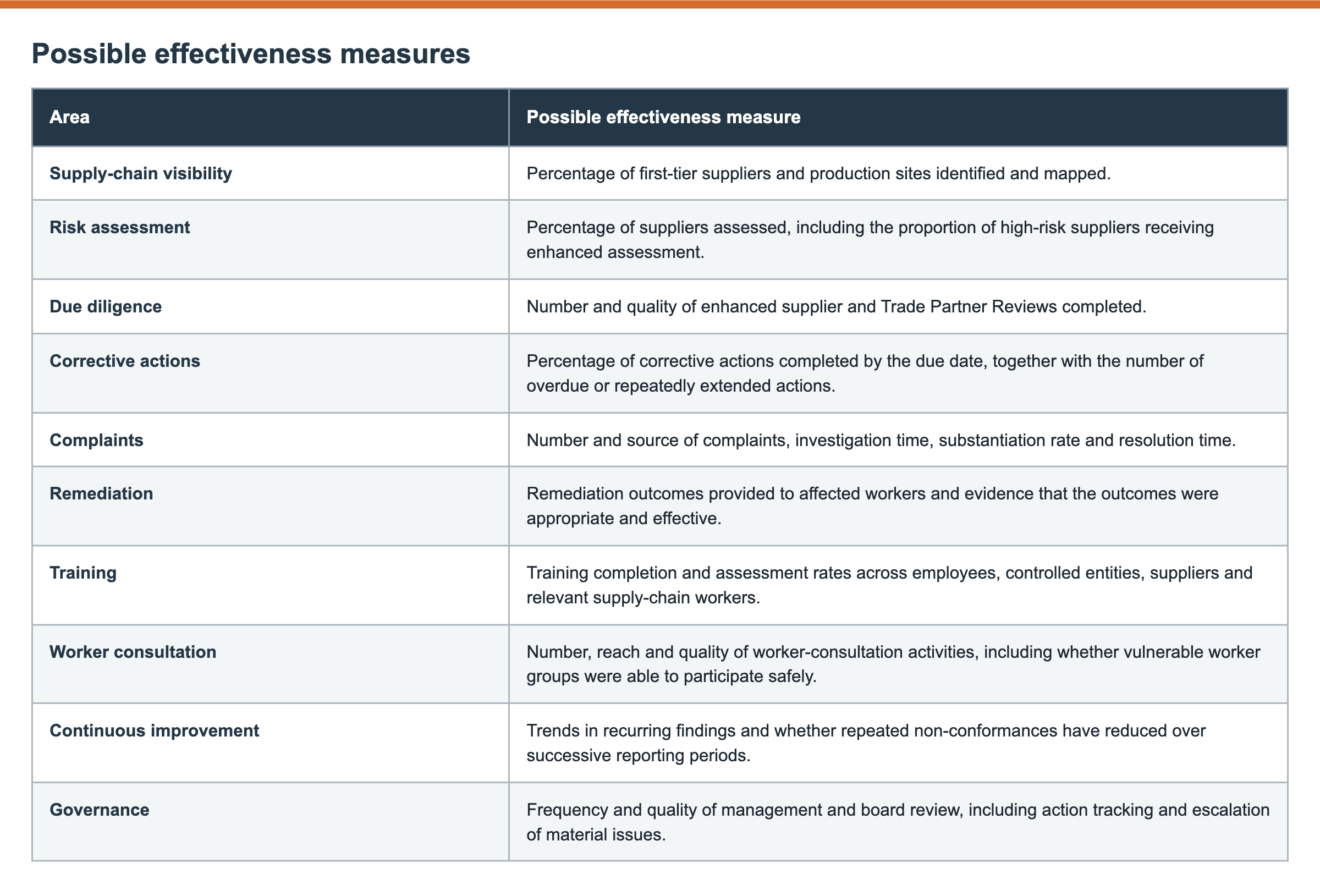
Measures should be reviewed over time to identify recurring findings, overdue actions, gaps in supply-chain visibility and areas where due diligence has not reduced risk.
10. Align governance and reporting calendars
A single responsible-sourcing system can support both regimes, but it must preserve the correct reporting period, entity, evidence and approval records for each statement.
How Watchdog Compliance can assist
Watchdog Compliance helps businesses translate modern slavery reporting requirements into practical, day-to-day processes.
Our support can include:
The Watchdog Responsible Sourcing Hub can bring together entity, supplier, risk, training, complaints, remediation, corrective-action and reporting evidence in one managed process.
This helps businesses move beyond annual statement preparation and establish an ongoing, defensible responsible-sourcing program.
Contact Watchdog Compliance to arrange an Australian-New Zealand modern slavery readiness review or discuss implementation of the Watchdog Responsible Sourcing Hub.
10. Align governance and reporting calendars
Businesses reporting in Australia may need to manage two evidence periods:
- the Australian financial reporting period; and
- the proposed New Zealand period from 1 April to 31 March.
A single responsible-sourcing system can support both regimes, but it must preserve the correct reporting period, entity, evidence and approval records for each statement.
How Watchdog Compliance can assist
Watchdog Compliance helps businesses translate modern slavery reporting requirements into practical, day-to-day processes.
Our support can include:
- legal-entity and reporting-perimeter reviews;
- Australian and New Zealand reporting gap assessments;
- modern slavery risk assessments;
- supplier and Trade Partner Reviews;
- policy, Supplier Code and contract reviews;
- supplier questionnaires and due-diligence frameworks;
- incident, complaints and remediation procedures;
- modern slavery training;
- worker and supplier consultation processes;
- effectiveness measures and governance reporting;
- preparation and review of modern slavery statements; and
- implementation of practical responsible-sourcing controls through the Watchdog Responsible Sourcing Hub.
The Watchdog Responsible Sourcing Hub can bring together entity, supplier, risk, training, complaints, remediation, corrective-action and reporting evidence in one managed process.
This helps businesses move beyond annual statement preparation and establish an ongoing, defensible responsible-sourcing program.
Contact Watchdog Compliance to arrange an Australian-New Zealand modern slavery readiness review or discuss implementation of the Watchdog Responsible Sourcing Hub.
This article provides general information and is current as at July 2026. The Modern Slavery Bill is not yet law and may be amended. Whether an entity is carrying on business in New Zealand or directly or indirectly controls another entity will depend on its particular circumstances. Businesses should obtain advice before determining their reporting obligations.
Flagship Services
Our flagship services give businesses practical, high-impact support in the areas where compliance risk most often affects products, customers, suppliers and growth.
Watchdog Compliance Membership
Access regular specialist legal and compliance support across consumer law, product safety, product recalls, privacy, spam, marketing and advertising claims, website and ecommerce reviews, supplier due diligence, responsible sourcing, training, risk assessments and regulator response issues.
Benefit: Practical guidance when questions arise, with a more predictable support model for busy teams.
Benefit: Practical guidance when questions arise, with a more predictable support model for busy teams.
Product Safety Compliance Hub
The Product Safety Compliance Hub is a managed product compliance system that helps businesses track product approvals, supplier evidence, test reports, safety data sheets, labelling checks, warning requirements, mandatory standards, product images, escalation notes and safety records in one practical workflow.
Benefit: Clearer product decisions, better evidence records and fewer last-minute compliance surprises.
Benefit: Clearer product decisions, better evidence records and fewer last-minute compliance surprises.
Regulator Response & Compliance Programs
Support for businesses responding to regulator enquiries, s87B undertakings, court ordered compliance programs, investigations, corrective actions and evidence requirements.
Benefit: Helps your team respond appropriately, keep better records and turn regulator obligations into practical actions.
Benefit: Helps your team respond appropriately, keep better records and turn regulator obligations into practical actions.
Training, Workshops & WC Academy
In-person workshop, online learning screen or team training sessions. Build practical compliance capability through tailored face-to-face, online and LMS-integrated training programs.
Benefit: Helps staff recognise risks earlier, make better decisions and apply compliance rules day to day.
Benefit: Helps staff recognise risks earlier, make better decisions and apply compliance rules day to day.